Hi, I'm Dev. I'm currently a senior at Mountain View High School in California, and I'm interested in brain-computer interfaces (BCIs) and the hardware that runs them. In particular, I want to make EEG-based systems affordable and private enough to use outside of a lab, both for people who have lost the ability to speak and for early detection of neurological disease. In my free time, I'm usually hiking, at the gym with friends, or thrifting for the resale business I run with my brother.
Microsoft Discovery Young Innovator Award, DAC 2026
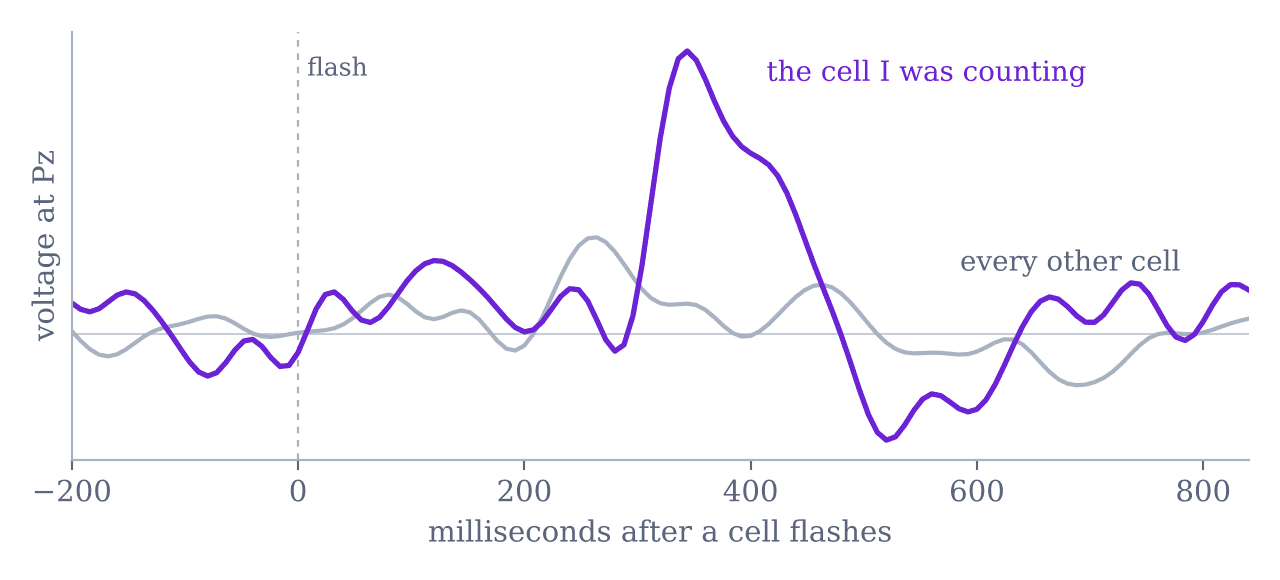
This project uses the P300, a small positive voltage that shows up in EEG about 300 ms after someone notices a stimulus they are waiting for, to let a user spell without moving. A 3×3 grid flashes one cell at a time in random order while the user silently counts how many times their chosen cell flashes. The classifier scores each flash and picks the cell with the strongest response, and two selections in a row are enough to reach any letter in the alphabet.
I was the only test subject, recording on myself with a dry-electrode headset over several weeks of sessions. In leave-one-trial-out testing, where every trial is predicted by a model that never saw it, the speller picked the correct cell at least 93% of the time.
Average response at Pz from my own recordings, comparing flashes of the cell I was counting (n = 103) with all other cells (n = 761), filtered 1–15 Hz. The peak lands at about 344 ms.
The main limitation is that, like most visual spellers, it assumes the user can move their eyes to look at the grid, which rules out patients with total locked-in syndrome. I'm currently working on a version that uses touch instead, with a small vibration motor on each wrist, so the user only has to pay attention to the buzzes on one side. The code and validation notes are on GitHub.
2025–present
SSVEP Communication Interface Independent
This project uses steady-state visual evoked potentials (SSVEP) to let someone choose between four spoken phrases (“I need water,” “Call the nurse,” “I am in pain,” and “I can't breathe”) by looking at one of four flickering squares. Each square flickers at a different frequency, and the visual cortex responds at that same frequency, which a TRCA classifier picks up from seven dry electrodes over the back of the head. In two live runs of 20 cued trials each, it chose the correct phrase 36 out of 40 times (90%).
Most of what I learned on this project came from debugging. At one point the classifier scored 97.5% in cross-validation but only 15% in live use, which is below chance. The cause turned out to be a single missing screen refresh call that shifted every live recording about 17 ms out of line with the training data. Cross-validation couldn't catch it because every fold had the same offset, so it only showed up once I ran a cued online test with known answers. The code and validation notes are on GitHub.
2025–present
EEG-8 Neural Co-processor CaretEDA internship
During my internship at CaretEDA, I designed an eight-channel EEG co-processor that cleans up the signal on-chip using Haar wavelets, so a device like my P300 speller wouldn't need a laptop to process the data after recording. It connects to a RISC-V core, and I wrote both the spec and the RTL myself. I took the design from RTL through synthesis, floorplanning, placement, routing, and timing closure in OpenLane on SkyWater's open 130 nm process. The final layout is 2.74 mm² with 87,763 standard cells, closes timing at 60 MHz, and is DRC and LVS clean.
This was my first time doing any kind of chip design. It took weeks of iteration to get right, although by the end a full pass from spec to signed-off layout only took a few hours using CaretEDA's agentic AI tools and the Microsoft Discovery platform. I presented the chip at the Microsoft booth at the Design Automation Conference (DAC) in 2026, where I demoed it to about 25 companies and received the Microsoft Discovery Young Innovator Award as the only high school recipient. The design has since been selected for fabrication.
Research
2026–present
Multiple Sclerosis Gene Expression miRcore
I analyzed a multiple sclerosis gene expression dataset using GEO2R, then used STRING and KEGG for protein interaction and pathway analysis. My hypothesis links downregulation of PSMD5 to proteasome dysfunction and impaired MHC class II antigen presentation, which I presented to around 70 researchers and faculty. I've continued with the year-long program as a volunteer on the NorCal committee and am co-writing a paper on the results.
Summer 2026
Invasive vs. Noninvasive BCI Literature ThinkNeuro
As a research intern, I ran a bibliometric analysis in R on 200 Web of Science papers, comparing how ethical and biological concerns are discussed in invasive versus noninvasive BCI research. I made the figures and co-authored the symposium abstract and conference poster.
Summer 2026
Molecular Imaging Mini-Fellowship Stanford School of Medicine
Through weekly sessions with Stanford faculty, I studied molecular imaging tools and recent advances in the field. For my final project I wrote a review on blood biomarkers for early Alzheimer's detection, focusing on which methods could realistically become cheap enough for routine screening. The report was recognized by faculty at the end of the program.
Summer 2026
Mental Privacy Capstone International Youth Neuroscience Association
For my capstone, I compared Stanford's 2025 study on decoding inner speech with how it was covered in the media, and wrote about what mental privacy protections would need to look like if this technology keeps improving. I also took part in a neuroethics debate with eight other students.
Other Experience
2023–present
Youth Community Service, Public Health Peer Leader. I started volunteering with YCS's Summer of Service in East Palo Alto as a freshman, and now lead a team of 11 students on substance abuse prevention and brain health projects. We've run two events for over 80 families and reached more than 25,000 people online.
Summer 2025
Scrollmark, QA Intern. I built and ran the QA process for SocialGPT, Scrollmark's AI tool, before its launch, working with the backend engineers. I logged 6 bugs in the YouTube and Instagram integrations and helped get 4 product-link fixes shipped.
2023–present
Resale Business, Co-founder. I run a resale business with my brother, sourcing undervalued clothing and electronics and listing them across four platforms. We've made over $3,500 in profit so far.
2023–present
JV Wrestling, Mountain View High School. I've wrestled for three seasons at 157 lbs and tied for 5th at the SCVAL League Championships. I also recruited two friends to the team and mentored three new freshmen.
Honors
2026
Microsoft Discovery Young Innovator Award, Design Automation Conference (only high school recipient)
2026
Recognition for Extraordinary Contributions, Stanford Summer of Neurosciences
2026
Distinction in R Programming and Bibliometric Methods, ThinkNeuro
2025
Mountain View City Council and Mayor's Recognition for volunteer service, one of 13 students citywide
2024
President's Volunteer Service Award, Gold, for service in East Palo Alto with the Ecumenical Hunger Program, the EPA Senior Center, and Allcove